

Issues & campaigns
When workers stand together and speak with one united voice, we can win important victories in our workplaces and our communities.
That's how we've won crucial advancements like paid sick leave, the highest minimum wage of any province, single-step union certification, trades certification and much more.
But there's a lot more to fight for. Here are some of the issues we're working on.
At a glance

Make work safer
Everyone deserves to come home at the end of their workday as safe and healthy as when they left. But for too many people, going to work means risking illness, injury or death. And many sick and injured workers face unfair and unjust treatment from the workers’ compensation system.
There’s no question things have improved since the BC Liberals, including John Rustad, dismantled many workplace protections and slashed workers' compensation benefits and eligibility. But there's a lot more left to do.
Multiple tower crane incidents have happened in the years following the Kelowna crane disaster, yet badly needed changes still haven’t happened. And safety threats ranging from violence to extreme weather aren’t being addressed with the urgency they deserve.
And the Workers' Compensation Board (or WCB, also known as WorkSafeBC) is failing many injured workers. Workers with psychological injuries face particular obstacles, with many of them having to jump through hoops to prove their injuries were caused in the workplace, adding to their stress when they should be focusing on healing and recovery. And benefits to injured workers, especially pensions, still haven't regained lost ground.
We're pushing for urgent action including:
- tower crane safety measures;
- workplace violence prevention;
- rules to prevent psychological injuries and promote good mental health at work;
- fair access to compensation for psychological injuries;
- stronger heat stress protections for workers in our changing climate;
- recognition of discrimination as a workplace hazard; and
- a genuinely worker-centred compensation system.

Build BC right
Right now, BC is building the most public infrastructure (bridges, transit, schools, hospitals and more) it has in a generation. And unlike in the past, our province is making sure that BC workers and local communities benefit. Community benefits agreements and project labour agreements ensure we're creating good, well-paying jobs — with high-quality training that helps address our shortage of skilled trades workers.
But the BC Conservatives want to scrap those agreements. They want to go back to the days big private employers would profit by paying lousy wages, failing to invest in training and hiring from outside BC. That would mean money going into corporate bank accounts instead of back into the community.
Speak out now. Workers want the benefits from public infrastructure investments to flow back to our communities. Let's train the next generation of skilled BC tradespeople in safe workplaces and jobs that let them support their families.
Make jobs priority #1
In March, when Trump was threatening 25% across-the-board tariffs, the province estimated that 124,000 workers will lose their jobs over the next four years, with BC’s unemployment rate rising to 6.7% this year and 7.1% next year.
If left unaddressed, that would be catastrophic to workers and communities across our province. And now Trump's threatening to hike the number to 35%.
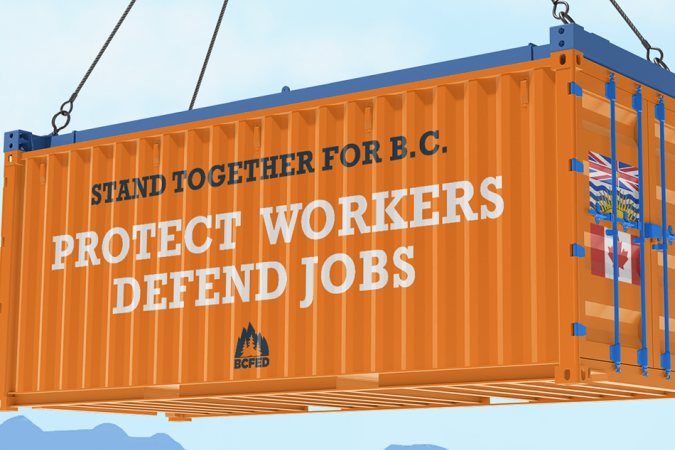
Our message is clear: The number one priority of all governments must now be to protect workers and defend their jobs. Workers are the backbone of our economy, and our province only prospers if working people prosper.
Whatever supports and initiatives emerge to help business weather this storm must be tied to preserving workers’ jobs. Defending jobs must be both the goal of these supports and the key measure of their success.
BCFED President Sussanne Skidmore is working with the provincial government’s BC Trade and Economic Security Task Force to keep workers’ voices front and centre, and to present a common united front.
You can help. Make sure our governments understand that in this fight, workers and good jobs must come first.

A vision for public transit throughout BC
Imagine: Public transit that gets you where you need to go — quickly, easily, reliably... and affordably. No matter where in BC you live.
This plan can make that vision a reality within the next decade.
We can fill the gaps left by years of neglect and privatization under past BC Liberal governments, and build on the important transit investments our current provincial government has made. And we can unite local and regional transit into an integrated, sustainable, zero-carbon whole.
1. Connect BC communities everywhere through a new province-wide express bus service.
Getting around BC by transit can be impossible. A province-wide public transit network will make it easier and safer for people in small towns and rural areas to get where they're going — whether it's to a medical appointment, a family birthday or a vacation.
2. Double the number of buses in BC Transit local services within five years and triple it within ten.
It's a lot easier to choose transit when you can rely on the bus coming on time and getting you where you need to go. (Not to mention having enough space for everyone at your stop!) And targeted services like community shuttle services, on-demand rides and car and bike sharing can close the gap between a transit stop and your front door.
3. Expand HandyDART service province-wide with an upgraded electric fleet.
Instead of relying on private companies and taxis for HandyDART services, let's expand HandyDART — including in small towns, rural and Indigenous communities — with new minibuses, cars and vans, and new public facilities and maintenance centres to communities across BC.
4. Develop new regional rail connections across the South Coast and Vancouver Island.
Restore and expand passenger rail services by expanding West Coast Express service and extending it to Abbotsford, building a new community rail line from Langley to Chilliwack on the Interurban corridor, restoring rail service to Prince George via Squamish and Whistler, and restoring the Vancouver Island Rail Corridor.
5. Create new passenger ferry connections.
New passenger ferries can dramatically increase BC Ferries’ capacity at much lower cost. Our plan adds new passenger ferry options between Vancouver, the Gulf Islands, Sunshine Coast and Vancouver Island
6. Accelerate TransLink’s 10-year Access for Everyone plan for Metro Vancouver.
Metro Vancouver is a critical hub for BC. Rolling out TransLink’s plan over the next five years instead of 10 will help clear congestion for riders and drivers alike, shift housing and other development, and boost our province's economy. And it'll set the stage for new rapid transit projects.
7. Integrate transit seamlessly throughout BC.
Instead of a patchwork of isolated transit systems, we can integrate all these transit pieces into a seamless, coordinated and coherent transit experience. With one-ticket access and synchronized infrastructure, riders can make connections efficiently and reliably across systems — and get the updates they need for their whole trip quickly and easily.
8. Expand existing free transit programs to all youth up to age 18.
Making transit free for all young British Columbians will provide some of the basic mobility they need to thrive, and help them develop the habit of using transit. Free transit programs should also expand to cover people on social assistance who are not already included in the BC Bus Pass program.

Make every job a living wage job
Every worker should be able to earn enough to live in the community where they work. That’s the idea behind the living wage.
It’s calculated using the expenses that a family in BC needs to pay, such as rent, food, transportation and child care.
The Living Wage for Families BC campaign calculates the current living wage in communities across BC. You can see the most recent living wage here. And what jumps out at you is how big the gap is between the living wage and the minimum wage.
We’re working to close that gap. By raising the minimum wage, and lowering the cost of living (especially housing), BC can make every job a living-wage job.
BC has made important progress, with the highest minimum wage of any province (now tied to inflation), historic investments in affordable housing, the elimination of MSP premiums and the expansion of $10-a-day child care. But we have a lot further to go to close that gap.
And when we do, everyone wins: Fewer workers and their families will be living in poverty. Employers will be able to attract and keep more of their employees, reducing turnover and training costs. And those higher wages will be spent in the community, growing local economies.

Workers with psychological injuries deserve dignity
Psychological injury is a growing hazard faced by all workers. And no workplace is immune from traumatic events.
Yet the Workers Compensation Act limits the compensation for psychologically injured workers. And it makes it harder for them to claim compensation for those injuries than for physical ones. No wonder the Workers' Compensation Board accepts barely one in three claims.
When the WCB denies a psychological injury claim, a worker's condition can become worse. They have to turn to other supports, like our already-strained public health system. Some fall through the cracks and don't get the help they need.
And because employers aren't help responsible for addressing unsafe conditions, the danger of more injuries remains.
But there's been progress. Since 2018, workers in several occupations have had presumptive coverage — where the WCB assumes a psychological injury was caused by work, unless proven otherwise.
Now it's time to extend that coverage to all workers. Let's stop singling out some workers and leaving others behind.
We're calling on the government to amend the Workers Compensation Act to:
- Replace the narrow term “mental disorders” with “psychological injury,” to capture the full range of injuries.
- Eliminate the higher standard of “predominately caused by work” workers must meet to show their psychological injury is caused by their work.
- Expand the options for a diagnosis to include general practitioners, so injured workers aren't waiting for months to be assessed.

It's time to close — not just disclose — the pay gap.
BC has made great progress in gender equality in recent years. But there’s one glaring area where we still lag badly: pay equity. BC has the fourth worst gender pay gap in Canada, with women earning on average 15% less than men.
Six of the seven provinces ahead of us (Ontario, Quebec, Manitoba, Nova Scotia, New Brunswick and PEI) have something in common: pay equity legislation that actively closes gender pay gaps. But not BC... yet.
Over half of BC women are employed in four low-paying sectors, and within those sectors, they’re concentrated in lower-paid positions. And this inequity toward women, two-spirit, nonbinary and trans workers is compounded when identities like Indigeneity, race, ability, sexual orientation and gender identity are involved.
The NDP government took an important step in 2023 with pay transparency legislation, requiring employers above a certain size to report every year on the pay gap in their organizations. (The new law also prevents employers from asking job applicants what they earned in previous positions, or disciplining employees for discussing their pay with each other.)
But that’s just a first step. BC workers need legislation that requires companies not only to reveal those gaps, but to address them. We’ve joined more than 125 organizations pushing for real pay equity.
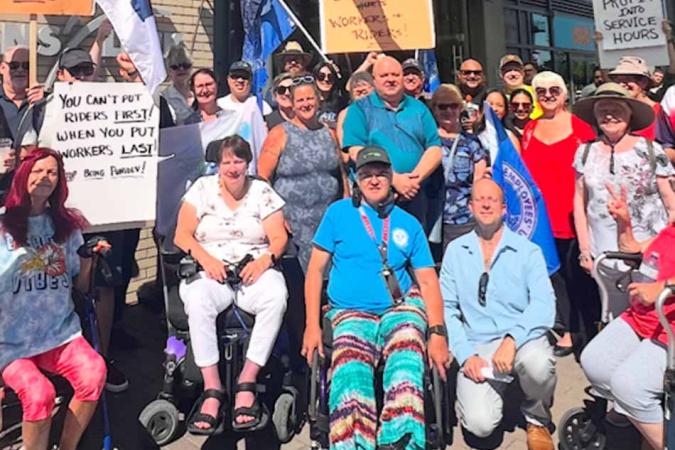
Make HandyDART public!
Tens of thousands of Metro Vancouver residents rely on HandyDART to get to daily medical appointments, adult daycare centres and other essential services. So why does TransLink rely on private companies that are notorious for poor safety practices, bad working conditions, and labour unrest to operate HandyDART?
A lack of accountability—and corporate profit-seeking— have led to HandyDART’s overreliance on taxis, myriad safety problems, unreliable service quality, and poor working conditions for drivers. In 2024, that led to a three-week long strike against Transdev, the private contractor.
In the last election, the BC NDP committed to bringing HandyDART under public control. We're calling on the province to keep that commitment.
Five city councils in this region have passed resolutions supporting bringing HandyDART in-house, six Mayors on the Regional Council of Transportation have signed an open letter backing that call, the Amalgamated Transit Union Local 1724 drivers are fully behind it, and more than 500 riders have signed the Save Our HandyDART petition. Workers and the HandyDART community are united on this issue.
You can lend your voice, too. Take a few seconds to send a pre-written letter to TransLink and Minister Farnworth urging them to do the right thing by riders and workers, and protect the future of this service by bringing HandyDART in-house.

Gig workers are being taken for a ride!
There are many workers in BC doing app-based gig work, like food delivery or ride-hail driving. But their employers — mostly huge corporations based in Silicon Valley — have tried to shut them out of essential employment protections, including fair pay, sick days and severance requirements.
These companies lobby governments relentlessly to get their way. And other employers are watching closely — because if companies like Uber and DoorDash can get special deals that let them off the hook for treating their employees fairly, maybe they can too.
Workers deserve flexibility and the same basic rights and protections other workers are entitled to, such as:
- fair pay for all the hours they work,
- health and safety protections and compensation for injuries on the job,
- paid sick days,
- transparency and accountability from gig companies, and
- the right to join a union.
In 2023, the BC government made partial progress for ridehail and food delivery workers, including affirming coverage through workers' compensation and some basic employment rights including pay for mileage.
But there's still a long way to go before app-based gig workers have the full protection they deserve. In particular, the "engaged time" model promoted by employers and adopted by the government pays workers only for part of the time they work. And the government's way of dealing with that — a top-up to the minimum wage — doesn't come close to closing the gap.
One great recent development: Uber drivers in Victoria unionized with UFCW 1518 in summer 2025!
As employers expand app-based work to other areas, it's crucial to ensure basic rights for workers no matter what form their work takes. And we'll keep fighting to make sure that happens.

How we make political change
We push hard to keep workers' priorities front and centre with governments at all levels. And we work to elect people who will listen to workers' voices.
When working people unite and speak with one voice, governments can't ignore us. The BCFED works to make sure government understands the most urgent issues facing workers. And we mobilize pressure in the community to make those changes happen.
That’s how we’ve won important victories for working people, including:
- Single-step certification: The old system was open to employer abuse and intimidation. By certifying a new union when 55% of workers sign cards, the province has allowed thousands of BC workers to access their right to organize for the first time.
- Canada's highest provincial minimum wage: After trailing the rest of the country under the BC Liberal government, BC now leads on the provincial minimum wage, indexed to inflation.
- Paid sick leave: Ensuring workers have a minimum of five days of paid sick leave was a major victory for BC workers.
We work during elections, too. We make sure parties and candidates know about the needs and concerns of working people. And we help inform workers where the parties stand—and who's standing with them.
BCFED leaders and staff meet regularly with government officials and agencies around key issues, especially those directly affecting the workplace such as safety regulations and employment standards. And we bring labour leaders together biannually with government leaders and MLAs to talk about the most critical issues on our agenda. Here are some of the background papers from those past meetings:
- Unions work for affordability
- Unions work to build BC
- Unions work for health and safety
- Unions work for equity
- How unions work — and how government can support them
- Ride-hail and food-delivery workers need rights
- Psychological injuries and presumptive coverage
- Recourse and protections for workers experiencing systemic racism
- Paving the way toward pay equity in BC
- Paid leave for workers experiencing gender-based violence