


Diversity, equity and inclusion
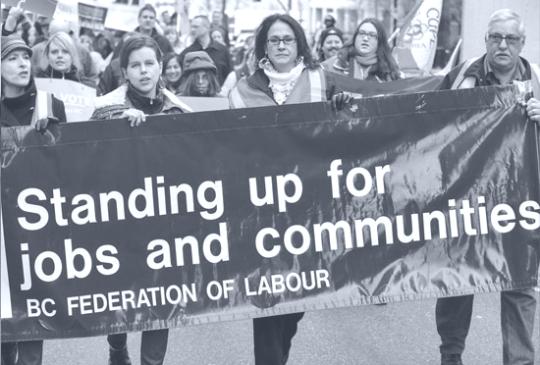
Labour unions fight for the rights of all workers. And that means working for equity, diversity, justice and inclusion — ending discrimination and injustice, and ensuring everyone can participate fully in the life workplace, the community and in the decisions that affect us.
The BCFED advocates for policies that address inequities in our workplaces, communities, laws and institutions. And we work for change in our movement, too, ensuring everyone’s voices are heard and removing obstacles due to age, ethnicity or race, Indigeneity, gender identity and expression, physical or mental disability, sexual orientation, socio-economic class, cultural histories, religion and faith identity and other protected grounds.
On this page
Equality vs. equity
Just treating everyone the same isn’t enough. Groups that have been historically excluded can be disadvantaged, and have a harder time being heard and understood. And some workers will require additional support to be able to have the same opportunities for success or to achieve the same levels of inclusion.
The goal of equity is to ensure all workers have an equal opportunity and access to opportunities in the workplace, community and within their union.
Equity caucuses
One of the ways the BCFED engages with equity-seeking groups, and helps amplify and center their voices, is through our equity caucuses. They're made up of union members who identify with a particular equity-seeking group. These groups meet regularly, bring forward issues and ideas, connect with organizations in the broader community and plan advocacy work.
Each caucus elects a representative to our Executive Council at our biennial Convention. If you’re a member of an affiliate union, and you identify as a member of the group represented by one of our caucuses, we hope you’ll join! Just fill out this short form and we’ll get back to you.
BCFED Caucuses and Equity Reps
Indigenous Workers
This caucus represents workers who identify as Indigenous.
This group is a place for Indigenous workers to network and to discuss issues of focus for Indigenous people at work and in society.
Executive Council representatives: Lynn Serhan and Marylou Fonda
2SLGBTQIA+ Workers
This caucus represents workers who identify as 2SLGBTQIA+ (two-spirit, lesbian, gay, bisexual, trans, queer, intersex, asexual plus).
This group is a place for 2SLGBTQIA+ workers to network and to discuss issues of focus for people who are members of the 2SLGBTQIA+ community at work and in society.
Executive Council representative: Kevin Taki and Desiree Cabecinha
Racial Equity and Justice
This caucus represents workers who identify as people of colour.
This group is a place for workers of colour to network and discuss issues of focus for people of colour in their work and home lives.
Executive Council representative: Sonia Andhi and Florentina Kelly
Accessibility Workers
This caucus represents workers who identify as people with disabilities.
This group is a place for workers with disabilities to network, and to discuss issues of focus for people living and working with disabilities.
Executive Council representative: Jennifer Marquez and Jovito Espinoza
Take action for equity at work
Ready to further your organization’s commitment to diversity, inclusion, equity and social justice but not sure where to start? Here are some actions we recommend:
Start with an equity audit of your members
The best place to start is with research. Contact the BCFED to learn how to conduct an audit of your membership that will reveal who is struggling with inclusion in your union.
Grow the cultural literacy of your leadership and members
It's much easier to provide supports or accommodations to workers who are experiencing barriers to inclusion when you and your members have greater levels of knowledge and understanding. For example, ensuring Indigenous workers feel included in union activities requires knowledge (or literacy) of local Indigenous language, culture and history. Some basic education around the cultural differences of workers is a great way to demonstrate the value of diversity within an organization.
Be accessible to members with disabilities
People with disabilities are one of BC’s most untapped pools of talent. Ensuring union activities and spaces are accessible is the minimum requirement by the law. But we can and should go beyond that, by engaging with workers who identify as having visible and invisible disabilities to identify and eliminate potential barriers to full inclusion.
Get Positive Space training
2SLGBTQIA+ workers often face barriers to full participation in workplaces and unions. The BCFED encourages members to use Positive Space trainings: programs, usually facilitated by 2SLGBTQIA+-serving groups, aimed at helping organizations create positive, inclusive spaces where 2SLGBTQIA+ workers can participate fully and feel safer in expressing their identities.
Engage and include First Nations and Indigenous workers
Canadians have made a public commitment to the revitalization of First Nations and Indigenous communities, including greater inclusion and more knowledgeable support in the workforce. By building meaningful relations with local First Nations and Indigenous workers, you can better understand their needs and expectations, and work more effectively toward Reconciliation.
Test and train for implicit bias
Uncovering your implicit or unconscious bias is key to identifying our “blind spots” and creating fair and barrier-free decisions and decision-making processes. Implicit Association Tests (IATs) are free, and can be followed-up with training on how to reduce the impact of implicit bias in our work. Take the test here.
Recognize cultural and multi-faith calendar dates
For many workers, faith and culture are core to their personal identities. Engaging your members to determine which dates are most significant, and recognizing these dates, helps them bring their whole selves to work and to union activities. As a starting point, the Affiliation of Multicultural Societies and Service Agencies of BC produces an annual multifaith calendar identifying significant dates for a wide range of faiths and faith identities. And the Canadian government provides an online list of major cultural and commemorative dates.
Recognize and celebrate human rights dates
Human rights dates refer to dates that are significant to human rights and diversity, as designated by the United Nations. Acknowledging and celebrating these dates through your membership brings your union into solidarity with social justice efforts throughout our local communities and around the world. The dates also provide an opportunity to engage workers of equity-seeking groups, and communicate the values of diversity, inclusion, equity and social justice.
Make use of consultants and facilitators
This is often complex work — and you don't have to tackle it on your own. There are many experienced experts you can engage to help you build capacity, develop action plans, conduct productive conversations, and provide training that's inspiring, powerful and valuable.
Form employee resource groups
Companies throughout Canada and the US are engaging their employees through employee resource groups (ERGs). Familiarizing, and even advocating for management-sponsored ERGs, deepens your engagement with workers and demonstrates your influence on employers. ERGs often have a senior executive as a champion, but require volunteer support to implement activities, programming and outreach into the community. In the area of diversity and inclusion, there is potential for unions and management to partner for the benefit of workers. For basics on how to start an ERG, please visit prideatwork.ca.
Encourage labour movement champions
Championing of diversity and inclusion by labour movements is not new. In fact, historically, it has been labour organizations fighting for fair wages, job security and pay-equity for various equity-seeking groups, that has transformed work conditions in the US and Canada. The role of union leadership in the advancement of diversity, inclusion, equity and social justice remains true today, but requires on-going encouragement and leadership development.
Make use of resources for diversity champions
There many online resources for those who are interested in supporting the efforts for greater diversity and inclusion. Get started here: